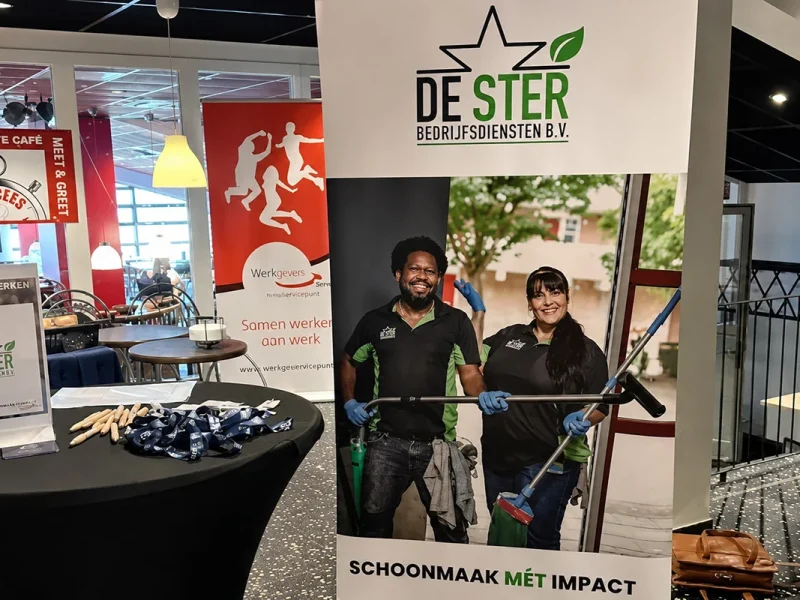
Last Thursday was all about workplace inclusion. Start Foundation and Utrecht University of Applied Sciences organised a day filled with inspiring speakers and valuable insights. I had promised myself I wouldn’t get frustrated, but unfortunately, I didn’t quite manage it…
A Promising Start
During the event on workplace inclusion, it became clear that the intentions are genuine. There is no shortage of funding, projects, or research. Yet, in practice, it often remains difficult to ensure that everyone has a real opportunity to participate in society.
The stories shared throughout the day showed that the problem rarely lies in a lack of opportunities. Instead, it is the way the system is organised that creates barriers. The many rules, procedures, and organisations involved often make things far more complicated than they need to be.
That is not only a disadvantage for society as a whole, but above all for the people who continue to be left behind.
An Overly Complicated Approach
When Paul van der Aa of Rotterdam University of Applied Sciences enthusiastically spoke about several research projects, I could feel my doubts returning. Earlier this year, when the report was presented, I had already questioned one particular project.
In that study, participants who wanted to learn a trade while continuing to receive benefits were automatically assigned three different job coaches: one during the selection process, one throughout the programme itself, and another to help them find a job afterwards.
On paper, that may sound like a well structured approach. In reality, however, it raises an important question. How can someone build trust with a coach when that person keeps changing? Instead of increasing the chances of success, such an approach may actually make success less likely.
Workplace Inclusion Requires Different Perspectives
After this presentation, the event continued at a steady pace. What struck me most was that one important perspective was largely missing from many of the discussions: the perspective of the people the entire system is meant to serve. The people with different needs and different life experiences who deal with the system every single day.
It was only towards the end of the event that this perspective finally emerged in a video presented by Start Foundation. It clearly showed how important it is to involve people themselves in designing the solutions that are intended to help them.
A Panel Without the Main Characters
The event concluded with a panel discussion featuring researchers and senior representatives from various organisations. They were undoubtedly knowledgeable speakers, but something stood out. Sitting in the audience were social entrepreneurs who work every day to improve workplace inclusion. They create jobs, support people, and make a real difference. Yet none of them were invited onto the stage.
Even more striking was the complete absence of another group: the people with disabilities or other barriers to employment themselves.
When one of the panellists suggested that mainstream employers were the main problem, I could feel my frustration rising. How is it possible that the very people this discussion is about were not given a place in the conversation?
Perhaps we should start with something simple: stop making the system unnecessarily complicated. Give people a voice of their own and work together with the organisations that prove every day that workplace inclusion can succeed.
Invitation
I would like to invite Start Foundation and Utrecht University of Applied Sciences to organise a different kind of event. One where the stage is reserved exclusively for people who experience the system first hand and for organisations that are already proving every day that inclusive employment works. Inspiration guaranteed!
Good news! Utrecht University of Applied Sciences immediately embraced the idea and invited Willem to speak at the conference Decent Work as an Opportunity on 8 November, focusing on diversity and inclusion in the workplace.
Photo credits: Groothoek Fotografie